
Last Updated on February 5, 2026 by Lila Sjöberg
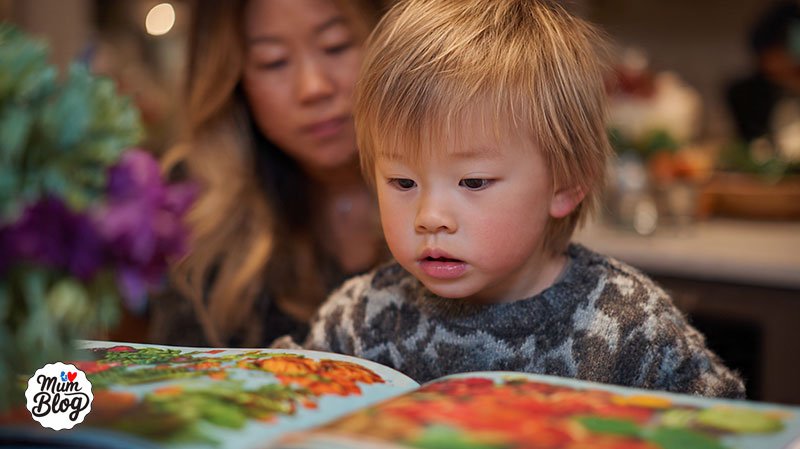
My daughter said her first French word at eighteen months — eau, pointing at her water cup — and I nearly cried. Not because it was particularly impressive (it is literally one syllable), but because it meant something was working. All those months of fumbling through my own rusty French, playing silly songs in the car, reading the same picture books over and over — she was actually absorbing it. If you have ever wondered whether raising a bilingual child is worth the effort, or whether French specifically is a good choice, let me share what I have learned from our journey so far. Allons-y!
Key Takeaways
Bilingualism strengthens cognitive skills including memory, problem-solving, and mental flexibility — benefits that extend far beyond language itself. French is one of the most practical second languages to learn, spoken across five continents and used in international organisations, business, and diplomacy worldwide. You do not need to be fluent yourself to raise a bilingual child; consistency and good resources matter more than perfection. Starting early takes advantage of children’s natural language acquisition abilities, but it is genuinely never too late to begin.
The Short Answer



Raising a bilingual child in French gives them cognitive advantages, cultural enrichment, and practical skills for their future. Start as early as possible, be consistent with exposure, make it fun rather than academic, and use quality resources designed for young learners.
Why Bilingualism Matters More Than You Think
I used to think bilingualism was mainly about communication — being able to order coffee in Paris or chat with relatives abroad. But the research on bilingual brains has genuinely surprised me. Children who grow up with two languages show enhanced executive function, better attention control, and stronger problem-solving abilities. Their brains become more flexible, more adaptable, better at filtering information and switching between tasks.
These cognitive benefits are not just about language. They spill over into mathematics, reading comprehension, and creative thinking. Bilingual children often outperform monolingual peers academically, not because they are inherently smarter but because their brains have been trained to work harder and more flexibly from an early age.
And then there are the doors that open later. In our increasingly connected world, speaking multiple languages is a genuine career advantage. But beyond employment, there is something deeper — the ability to connect with different cultures, to travel more meaningfully, to understand that the world is bigger and more varied than any single perspective can capture. That is a gift I want to give my children.
Why French Specifically
With so many languages to choose from, why French? Partly, I admit, it is personal — I studied French at school and wanted to finally put those years to good use. But there are genuinely practical reasons too, et oui! 😊
French is spoken by over 300 million people across five continents. It is an official language of the United Nations, the European Union, NATO, and the International Olympic Committee. It is the language of diplomacy, international law, and countless global organisations. For a child growing up in today’s world, French opens doors that many other languages simply cannot.
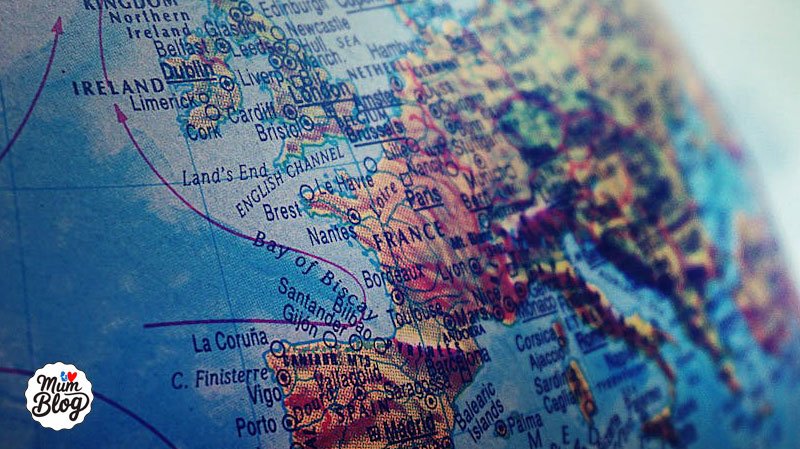
French is also considered one of the more accessible languages for English speakers to learn. The vocabulary overlap is significant (thanks to the Norman Conquest, roughly 30% of English words have French origins), and the grammatical structures, while different, follow logical patterns that children can grasp.
And honestly? French is beautiful. The sounds, the rhythm, the way it feels in your mouth — there is a reason it is called the language of love. I want my children to experience that beauty, to have access to French literature and film and music in their original forms, to feel at home in francophone cultures around the world.
How We Actually Do It
I want to be honest with you: I am not fluent in French. My accent is questionable at best, and I regularly make grammatical errors that would horrify my old French teacher. But here is what I have learned — perfection is not the point. Consistency and exposure are what matter most. I sometimes practice my French pronunciation on this website with native NON AI voices, it’s free, try it! (it’s kid friendly too).
We started from birth, which sounds impressive but really just meant playing French lullabies during feeds and narrating nappy changes in broken French. As my daughter grew, we added French picture books, cartoons, and songs. We established routines where French was the default — bath time became French time, car journeys meant French music.
The key is making it natural rather than academic. Young children do not need grammar drills or vocabulary tests. They need exposure, repetition, and positive associations. When French feels like fun rather than a lesson, they absorb it effortlessly.
We also found that having dedicated resources made an enormous difference. Trying to improvise French content every day was exhausting and inconsistent. But having a structured workbook to work through together gave us a framework, a routine, something to return to daily that built systematically on what came before.
The Resource That Changed Everything
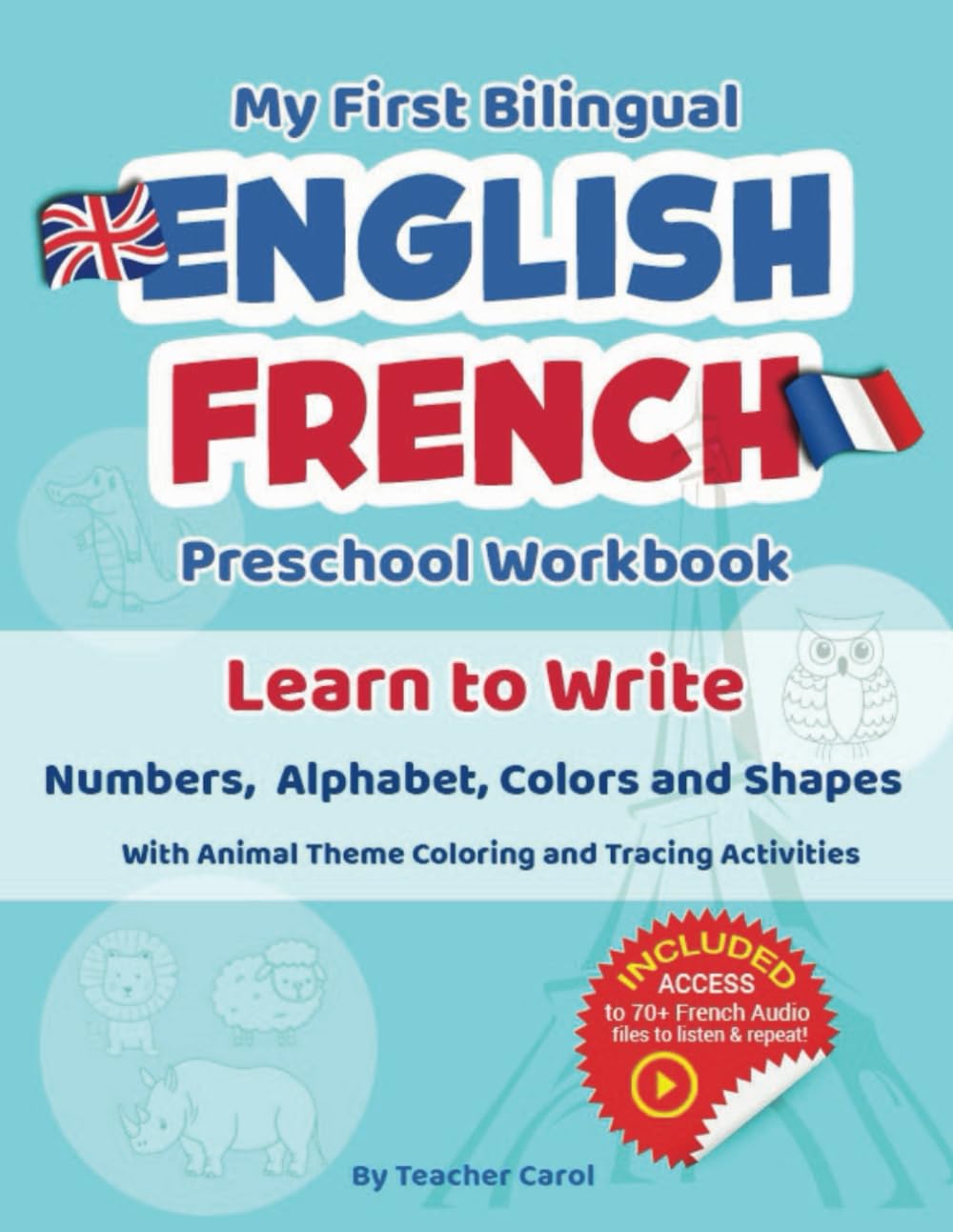
After trying various apps, videos, and random library books, I finally invested in a proper bilingual workbook designed specifically for young children. My First Bilingual English / French Preschool Workbook by Teacher Carol became our daily go-to, and I genuinely cannot recommend it enough.
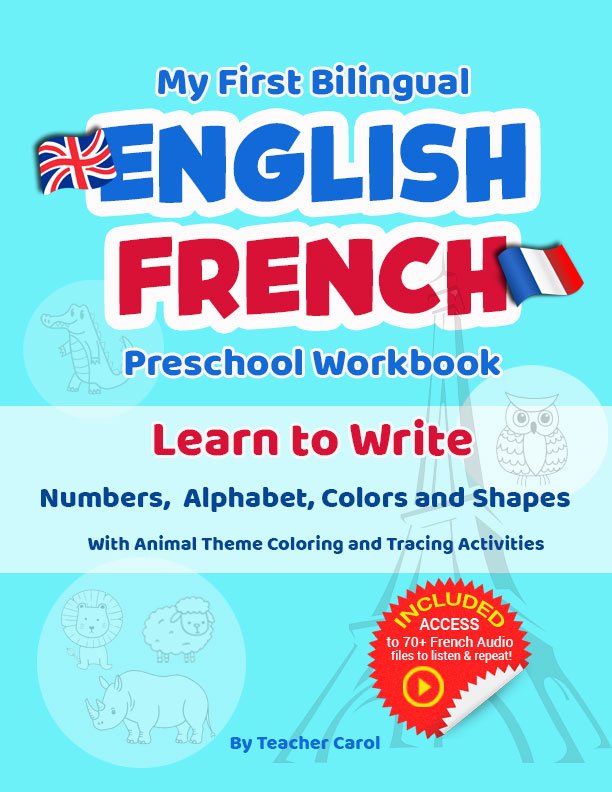
What I love about it is the approach. The activities are genuinely engaging — not just worksheets but puzzles, colouring, matching games, and tracing exercises that my daughter actually wants to do. Each page builds vocabulary and recognition in a way that feels like play rather than study. And crucially, it includes free access to French audio files so you can hear proper pronunciation even if your own French is rusty.
We do a few pages together most days, usually in the morning while eating breakfast or in the quiet time before bed. It takes maybe ten or fifteen minutes, but the consistency adds up. My daughter now recognises dozens of French words, can count to twenty, knows her colours and animals, and — most importantly — associates French with positive, connected time with me.
If you are looking for a concrete place to start your bilingual journey, this workbook is genuinely where I would point you. It takes the guesswork out of what to teach and how to teach it, which is invaluable when you are already juggling everything else parenthood throws at you.
Common Challenges (And How to Handle Them)
Raising a bilingual child is not without its bumps. Here is what we have encountered and how we have navigated it.
Language mixing worried me at first. My daughter would say sentences that were half English, half French, and I wondered if we were confusing her. But this is completely normal and actually shows her brain is working hard to integrate both languages. Research confirms that mixing decreases naturally as children develop — their brains are sorting, not struggling.
Resistance happens too. There have been phases where my daughter refused to respond in French or complained that she did not want to do our workbook. When this happens, I back off the pressure and find ways to make French feel fun again — a silly song, a favourite cartoon, a game where French words earn points. Forcing it creates negative associations that undermine the whole project.
My own limitations sometimes frustrate me. I mispronounce things, forget vocabulary, make errors she might absorb. But I have made peace with being imperfect. Exposure to native speakers through audio resources, videos, and eventually classes or tutors will smooth out whatever rough edges I introduce. My job right now is to build the foundation and the love for the language — the polish can come later.
Raising a Bilingual Child FAQ
Is my child too young (or too old) to start?
Children’s brains are optimised for language acquisition from birth through around age seven, so earlier is generally easier. But it is genuinely never too late — older children and even adults can become proficient with the right approach. Start wherever you are.
Do I need to be fluent to raise a bilingual child?
No. Consistency and quality resources matter more than your personal fluency. Use audio materials for proper pronunciation, supplement with native-speaker content, and learn alongside your child. Your willingness to try models something valuable regardless of your skill level.
Will learning two languages confuse my child or delay their speech?
Research consistently shows that bilingualism does not cause language delays or confusion. Bilingual children may have slightly smaller vocabularies in each individual language initially, but their total vocabulary across both languages is typically equal to or greater than monolingual peers. Any perceived delays even out by school age.
How much time do I need to dedicate daily?
Even fifteen to twenty minutes of consistent daily exposure makes a difference. The key is regularity rather than marathon sessions. Short, enjoyable interactions build language skills more effectively than occasional intensive efforts. Our indoor activities guide has ideas for incorporating learning into play.
Start Today
Here is what I want you to take away from all of this: you can do this. You do not need to be fluent, you do not need expensive programmes, you do not need to overhaul your entire routine. You just need to start, stay consistent, and make it enjoyable.
Begin with small things. A French song in the car. A bilingual book at bedtime. Ten minutes with a workbook designed to make learning feel like play. These small daily deposits accumulate into something remarkable — a child who moves comfortably between languages, whose brain has been strengthened by the cognitive demands of bilingualism, whose world is bigger because they can access it in more than one way.
My daughter is still young, and we have a long way to go on our French journey. But every new word she learns, every time she surprises me with something she has absorbed, reminds me why we started. The gift of language is one of the most valuable things we can give our children. And it starts with a single word.
Are you raising bilingual children or thinking about starting? I would love to hear what languages you are working on and what resources have helped you — we are all learning together right?
Lila.



We bought this bilingual workbook a couple of months ago, so way before this article, and my daughter still asks for it once in a while. Her pronunciation is getting so good! Already thinking about what to get next to keep the momentum going. Merci, Lila!
Thanks Nathalie, it happens that I know Teacher Carol, she’s doing a great job teaching toddlers English online and, from what I know, this publication was supervised by my mentor (Simon). You can be sure the French is correct, validated and not AI! 😊