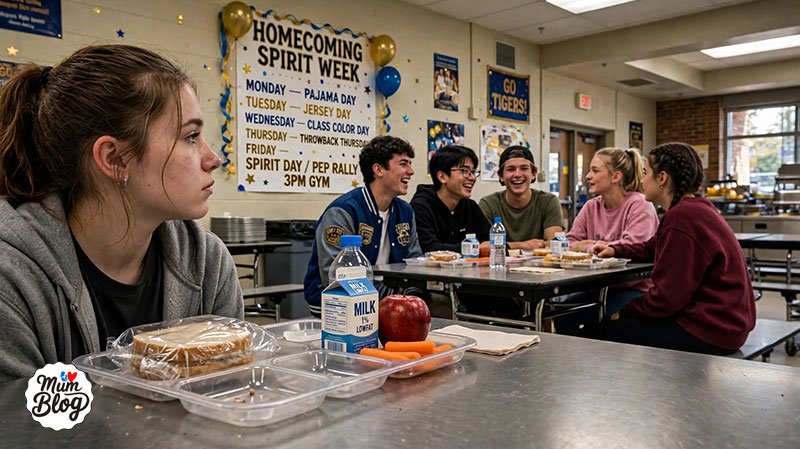
A friend of mine spent the better part of her daughter’s fifteenth year convinced that the problem was Maya. Maya was the new girl at school, the one with the eyebrow piercing and the older boyfriend, the one who had arrived in September and by December seemed to have completely rewritten her daughter’s personality. “Before Maya,” she would say, “she was fine.” I have heard some version of this sentence from almost every parent I know who has been through a difficult patch with a teenager. Before that group. Before those friends. Before whatever external force we decide arrived and did the damage. It is a story that feels completely true. The research suggests it is mostly backwards.
The idea that peer groups shape teenagers is not wrong, exactly. But it is incomplete in a way that matters. What developmental psychology has been finding, with increasing consistency across the past few decades, is that adolescents are not passive recipients of peer influence. They are active social agents who select their peer groups based on who they already are, who they are becoming, and what they already believe. The friend group is often a consequence, not a cause.
The Selection Effect
Developmental psychologists call it the selection effect, and it describes a pattern that shows up repeatedly in longitudinal research: adolescents tend to choose friends whose values, behaviours, and attitudes already resemble their own. This is distinct from, and often more powerful than, the influence effect, which describes how peer groups then reinforce and amplify existing tendencies. Both effects are real. But the selection effect comes first.
Po Bronson and Ashley Merryman examined the evidence on peer influence in NurtureShock and found that parents systematically overestimate how much peer groups change children and underestimate how much children’s pre-existing traits drive which peer groups they end up in. A teenager who is already drawn toward risk-taking is more likely to seek out, and be accepted by, peers who take risks. A teenager who values academic performance is more likely to gravitate toward peers who do the same. The group tends to reflect the teenager rather than create them.
The selection effect consistently precedes the influence effect in adolescent peer research. Teenagers choose friends who already resemble who they are and who they are becoming. The peer group is often a mirror before it becomes a force.
What the Adolescent Brain Is Actually Doing







To understand why this happens, it helps to understand what is happening neurologically during adolescence. Frances Jensen’s account of teenage brain development in The Teenage Brain explains that the prefrontal cortex, the region responsible for impulse control, long-term planning, and consequence assessment, is the last part of the brain to fully mature, a process that continues into the mid-twenties. What is developing rapidly during adolescence is the social and emotional brain: the regions responsible for processing social information, reading others’ intentions, and navigating group dynamics.
This means that teenagers are not simply being irrational when they appear to prioritise their social world over everything else. Their brains are specifically calibrated, during this developmental window, to be exquisitely sensitive to peer relationships and social belonging. This sensitivity is not a flaw; it is the mechanism through which human beings have always learned to operate in groups. But it also means that the social choices an adolescent makes are deeply tied to their developing sense of identity, not merely to whoever happens to be nearby.
The adolescent brain is not broken or incomplete. It is specifically calibrated to prioritise social information and peer belonging during the identity formation years. The intensity of peer focus is neurologically appropriate. What it reveals about identity is the part parents tend to miss.
Identity First, Group Second
Sarah-Jayne Blakemore’s research on the social brain in adolescence, synthesised in Inventing Ourselves, makes a point that I found genuinely reorienting as a parent: the peer group an adolescent chooses is often an expression of the identity they are trying on, not the identity that the group imposed on them. When a teenager moves toward a particular social world, they are frequently moving toward a version of themselves they want to explore. The group makes that version feel possible and legitimate.
This does not mean that peer groups have no influence. They clearly do. Once inside a group, teenagers are shaped by the norms and behaviours that group reinforces. Blakemore’s research and the broader literature suggest that both processes operate: selection and then influence. But starting with the group as the problem misses the step that preceded it. If we only focus on removing a child from a peer group without understanding what drew them there in the first place, we are treating the symptom while leaving the underlying signal unread.
The Signals Parents Often Miss
When I think about my friend and Maya, what I notice in retrospect is that there were earlier signs that she was not looking at: her daughter’s growing frustration with school, her sense that she did not fit with her old friend group, a restlessness that had started the spring before Maya arrived. Maya did not create the opening. She walked through a door that was already open.
This is the pattern that research keeps returning to. Teenagers who drift toward peer groups that concern their parents are often already experiencing something, before the group appears, that the group then addresses: a sense of not belonging, a desire for excitement or autonomy, a shift in values that has not yet been named or discussed at home. The group becomes visible and easy to blame. The earlier signals, which required a different kind of attention, were harder to see.
Research on adolescent peer selection consistently finds that the move toward a new peer group is preceded by changes in the adolescent’s own attitudes and values. The peer group tends to arrive after the shift, not before it. Addressing only the group leaves the underlying shift unexamined.
What This Changes for Parents
None of this means peer groups are irrelevant or that parental concern about them is misplaced. Peer environments do matter. Research is clear that the influence effect is real, and that some peer contexts are more harmful than others. But the question the research keeps redirecting us toward is: what was already happening with your teenager before this group appeared?
That question is harder to answer than “what is Maya doing to her.” It requires looking at what our teenager was already feeling, what needs the new group is meeting, what version of themselves they are trying to become, and whether there is a way to engage with that directly rather than focusing our energy on the group itself. The lagom approach here is not to ignore peer influence or to allow anything. It is to add a layer to the analysis. The peer group is information. The more useful question is what it is telling us.
Parenting is the longest experiment any of us will ever run. I am still reading the results.
Lila Sjoberg


Sources
- Peer Selection and Socialization Effects on Adolescent Risk Behavior, Journal of Research on Adolescence
- The truth about peer pressure, American Psychological Association Monitor
- The social brain in adolescence, Nature Reviews Neuroscience, Blakemore 2008
- Selection and socialization of antisocial behavior during adolescence, Journal of Adolescent Health
- Peer influence and adolescent behavior, Encyclopedia on Early Childhood Development