Last Updated on October 12, 2026 by Lila Sjöberg
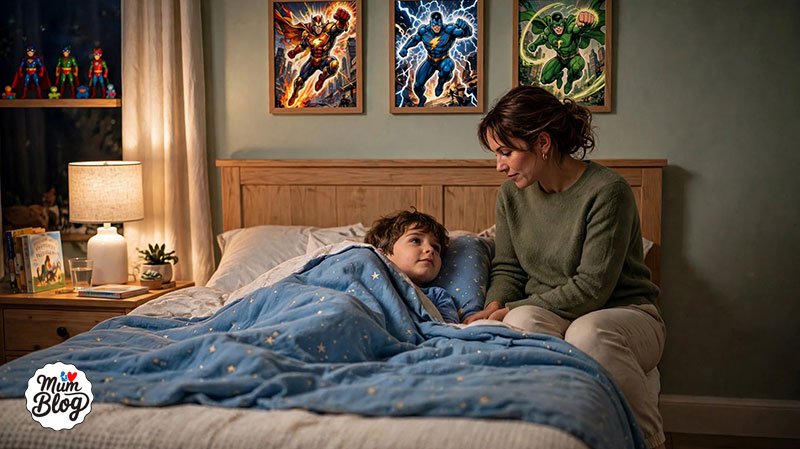
Ask most adults what they remember about their childhood evenings and the answers follow a pattern. Not the birthday parties. Not the holidays. Not the expensive days out that their parents planned for weeks. What they remember is something smaller: a parent sitting on the edge of the bed, the room almost dark, a conversation that went nowhere in particular but felt like everything at the time.
This is not nostalgia being sentimental. It is memory being accurate. The bedtime conversation occupies a specific and privileged position in how children form lasting emotional memories, and the mechanism behind it has been studied closely enough that the pattern holds up under scrutiny.
Why the Brain Remembers Bedtime
Memory consolidation, the process by which short-term experiences become long-term memories, happens primarily during sleep. The hours immediately before sleep are not neutral. They are the brain’s loading zone: what enters the mind in the thirty to sixty minutes before sleep onset is disproportionately likely to be processed, encoded, and retained.
A child who talks through the day’s events at bedtime is not simply winding down. They are actively consolidating those events into memory, with a parent present as the emotional anchor for how those events get stored. The parent’s tone, their attention, their questions shape not just what is remembered but how it is remembered.
Daniel Siegel’s work on interpersonal neurobiology describes this as co-regulation: the child’s nervous system uses the parent’s calm, attentive presence to organise its own emotional state. At bedtime, when the child is tired and the defences are lower, this co-regulation goes deeper than it can during the busy hours of the day. The child is more open. The parent’s presence registers more completely.
The Myth of the Big Moment








There is a persistent belief in modern parenting culture that what children need is quality time, usually defined as planned, active, special experiences. The birthday treat. The weekend trip. The carefully arranged outing that the parent has been looking forward to as much as the child.
These experiences matter. They are not nothing. But the research on attachment and memory consistently finds that they are not the primary material from which children construct their sense of being loved and known.
Gordon Neufeld’s attachment research identifies what he calls the collecting ritual: the small daily act of reconnection that signals to a child that they have not been forgotten, that the parent is still oriented toward them. Bedtime is the most powerful collecting ritual most families have, and most families underestimate it entirely.
The special outing is a single data point. The bedtime conversation, repeated hundreds of times across childhood, is a pattern. Children do not build their internal model of the parent-child relationship from single data points. They build it from patterns. The nightly ritual of being seen, heard, and settled by a present parent writes itself into the child’s nervous system in a way that no single extraordinary day can replicate.
What the Conversation Does Not Have to Be
Parents who understand that bedtime matters sometimes make the mistake of trying to make bedtime important. They arrive with questions, with intention, with topics they want to cover. The child, sensing the agenda, closes down.
The bedtime conversation works precisely because it is low stakes. It does not need to cover anything. It does not need to solve problems or extract information or deliver lessons. The most effective version of it is the one that follows the child’s lead: what did they think about, what did they notice, what are they worried about or curious about or looking forward to.
Kim John Payne describes the evening wind-down as a kind of decompression chamber, a transition space between the stimulation of the day and the rest of the night. The parent’s job in this space is not to be interesting or informative. It is to be present and unhurried, which in the context of most families’ days is already a radical act.
Unhurried is the operative word. A parent who sits on the edge of the bed already planning the next thing they have to do is physically present and psychologically absent. Children read this with unerring accuracy. The conversation that matters is the one where the parent has, at least for these few minutes, genuinely stopped.
The Long Arithmetic
A child who goes to bed at eight and starts school at five has roughly a thousand bedtimes before they begin to need the ritual less. A thousand evenings of a parent sitting in the dark, asking nothing in particular, being available for whatever comes up.
Some of those evenings will be unremarkable. The child will be tired and the conversation will be three sentences. Some of them will produce the kind of disclosure that never happens at the dinner table: the worry that has been sitting all week, the thing that happened at school that they could not find the words for until now, the question about death or fairness or why people are unkind that arrives without warning at nine-fifteen on a Tuesday.
You do not know in advance which bedtime will be the one they remember. This is why you show up for all of them.
The parents who look back with the least regret are not the ones who organised the most extraordinary experiences. They are the ones who were reliably present for the ordinary ones. The ones who stayed a little longer than they needed to. The ones who did not check their phone.
The conversation does not have to be memorable to become a memory. It just has to happen.
Now you know. The question is what you do with it.
Lila Sjöberg