Last Updated on October 13, 2026 by Lila Sjöberg
My daughter came to me one Tuesday afternoon and said she had nothing to do. She was seven. I was in the middle of something and I did not reach for the tablet, did not suggest a craft, did not offer to play a game. I said: “I know. You will think of something.”
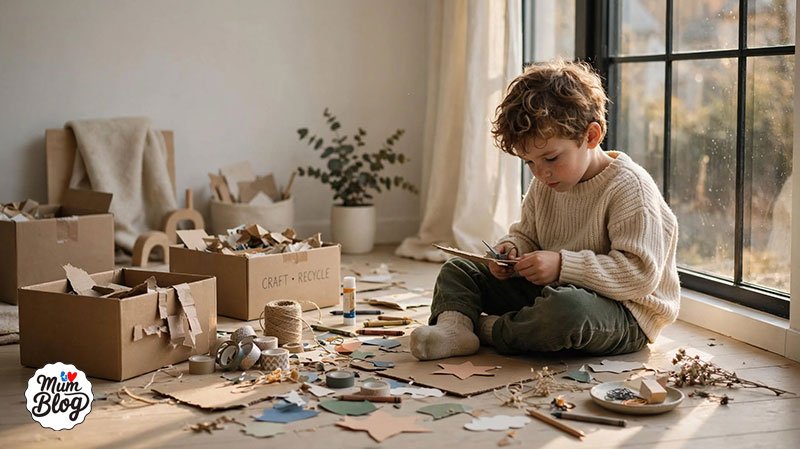
She stood in the doorway for a long moment, clearly hoping I would change my mind. Then she disappeared. Twenty minutes later she had constructed a small town out of cardboard boxes in the hallway, named every building, and was collecting rent from her stuffed animals.
I want to be honest: I did not do this because I was a wise parent. I did it because I was busy. But what happened next was not an accident, and understanding why it happened changed how I think about the whole question.
The Myth We Inherited
We have absorbed, somewhere along the way, the idea that a bored child is a failing child. That boredom signals under-stimulation, poor planning, or a gap in the schedule that a responsible parent should fill. Enrichment classes, screens, organized playdates, structured activities: we have built an entire infrastructure around the premise that childhood boredom is a problem to be solved as quickly as possible.
The research does not support this premise. It quietly contradicts it.
Boredom is not the absence of learning. In specific neurological terms, it is a state in which external stimulation has dropped below a threshold and the mind begins to generate its own. This is not a malfunction. This is, arguably, the condition under which the most distinctly human kind of thinking happens.
A child who is never bored is a child who has never had to reach inside themselves for something. Every time we fill the gap, we fill it for them, and they never practice the reach.
What Happens in the Gap








Neuroscientists call it the default mode network: the brain activity that switches on when we are not focused on a task. For a long time, researchers considered this cognitive background noise, the brain idling between real work. We now know it is something else entirely.
The default mode network is where we consolidate memory, imagine future scenarios, process social and emotional experiences, and generate creative connections between unrelated ideas. It activates during daydreaming. It activates during boredom. It is, in a meaningful sense, where the self is assembled and where a child begins to understand what they think, want, and care about.
Children who are given unstructured time, time with no agenda, no device, no adult directing the activity, show measurably stronger capacity for imaginative play, self-directed problem solving, and what developmental psychologists call intrinsic motivation: the ability to find work rewarding for its own sake rather than for external reward.
Unstructured time is not empty time. It is the time the brain uses to do the work no lesson plan can schedule.
The Screen Problem
The reason this matters more now than it did a generation ago is the screen. A smartphone or tablet is, in neurological terms, an extremely efficient boredom-elimination machine. It floods the brain’s reward system with novelty at exactly the moment the default mode network would otherwise activate. The gap closes before it opens.
This is not a moral argument against screens. It is a practical observation about timing. A child who reaches for a device the moment boredom arrives never experiences the discomfort that precedes the creativity. The device is not the problem. The reflex is.
Research on children’s media use consistently finds that passive consumption, scrolling, watching, absorbing, does not produce the cognitive benefits of unstructured play even when the content is educational. The benefit of boredom does not come from what fills it. It comes from the child doing the filling.
The Lagom Principle Applied
In Sweden, there is a long tradition in early childhood education of frilek, free play: time set aside where children choose their own activities with minimal adult intervention. It is not chaos. It is intentional. Educators watch, stay nearby, ensure safety, and otherwise trust the children to find their own way through the hour.
What they have observed over generations aligns closely with what the research now describes. Children at frilek learn to negotiate, to initiate, to fail and try again without an adult reframing the failure for them. They learn to be bored and then, crucially, to move through the boredom toward something. That movement is not trivial. It is practice in a fundamental life skill.
The lagom approach is not to create maximum boredom or refuse all structure. It is to leave deliberate gaps. Not every afternoon accounted for. Not every moment stimulated. Enough space that the child has to generate something from within.
We do not raise independent thinkers by thinking for them. We raise them by stepping back, consistently and with intention, and letting the thinking happen.
What This Looks Like in Practice
I am not suggesting you hand a seven-year-old a blank afternoon and walk away. A child who has been over-scheduled for years may experience the first unstructured hours as genuinely distressing, because they have not had practice. The tolerance for boredom, like any capacity, develops through use.
What works, in my experience and in the research, is starting small. One hour without a screen or a structured activity. No suggestions offered unless asked. A gentle “I trust you to find something” rather than a list of options. And then staying close enough to be present without being directive.
The first few times, many children hover at the edge of the gap, testing whether you really mean it. When they realize you do, something shifts. The cardboard cities appear. The elaborate games with rules that only make sense to the children playing them. The afternoons that somehow stretch in ways that scheduled ones never do.
My daughter is ten now. She still comes to tell me she is bored sometimes. I still say: “I know. You will think of something.” She rolls her eyes. And then she goes and thinks of something.
That is the whole lesson.
Parenting is the longest experiment any of us will ever run. I am still reading the results.
Lila Sjoberg


Sources