Last Updated on October 14, 2026 by Lila Sjöberg
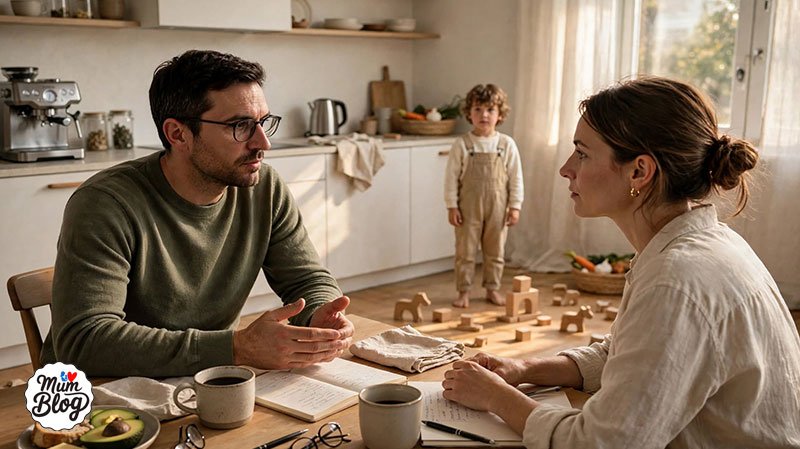
When my children were small, my partner and I had an unspoken agreement. Disagreements happened in the kitchen after bedtime, voices low, door half-closed. We were protecting them, we told ourselves. From the tension, from the uncertainty, from the sight of the two people they trusted most disagreeing about something as ordinary as money or schedules or who said what to whose mother.
We were not unusual. Most parents I know operate the same way. Conflict is something to be managed away from children, something they should not have to carry. It is a reasonable instinct. It is also, the research suggests, not quite right.
What Children Learn When We Argue in Front of Them
The question researchers have been asking is not whether children should witness conflict. They will, inevitably. The question is what kind of conflict they witness, and what they see happen after it.
Studies on family dynamics and child development have consistently found that children raised in homes where adults disagree openly but respectfully develop stronger emotional regulation skills than children raised in homes where conflict is entirely suppressed. They learn that tension is survivable. That two people can hold different positions and still remain connected. That anger does not mean abandonment.
What damages children is not witnessing conflict. What damages them is witnessing conflict that is contemptuous, unresolved, or followed by cold silence. The disagreement itself is not the wound. The handling of it is.
This distinction is one that parenting culture has been slow to absorb, and one that changes everything about how we think about protecting our children.
The Myth of the Conflict-Free Home






There is a version of good parenting that looks like seamless agreement. Two adults who coordinate without friction, who present a unified front on every decision, who save their differences for a room the children cannot enter. It looks stable. It looks safe.
But children are extraordinarily perceptive. They sense tension without being told about it. They notice the quality of silence. They register the shift in the air when something is not being said. Research by John Gottman and his colleagues found that children as young as three can detect elevated stress hormones in parents, even when the parents believe they are concealing their emotional state entirely.
When children sense conflict but see none of it processed, they fill the gap themselves. They assume the problem is them. They learn that emotions are things to be hidden rather than handled. The protection we offer them teaches them, quietly, that feelings are dangerous.
This is the cost of the conflict-free performance. Not the conflict itself, but the lesson embedded in its absence.
What Productive Disagreement Looks Like to a Child
What researchers call constructive conflict has specific features that children can observe and absorb. The adults listen to each other. They use language that names feelings without assigning blame. They may raise their voices slightly, but they do not attack each other’s character. And critically, they reach some form of resolution, or at least acknowledge that the conversation is ongoing and that both people are still in it.
A child who sees this is seeing something valuable. They are seeing that relationships can hold disagreement. That their parents are separate people with separate views who have chosen to work something out rather than walk away. That the friction between two people who love each other is not the end of something.
This is the emotional vocabulary we say we want our children to have. We just forget, in our anxiety to protect them, that the only way to teach it is to use it in front of them.
The Resolution Matters More Than the Argument
The single most important variable in the research on children and parental conflict is not the intensity of the argument. It is what happens after. Children who see their parents disagree and then reconnect, who witness repair as well as rupture, develop a fundamentally different internal model of relationships than children who see conflict end in withdrawal or prolonged tension.
Repair is the skill. Conflict is just the opportunity to demonstrate it. When children watch two adults come back together after a genuine disagreement, they are learning something that no book, no class, and no carefully worded explanation can teach them as effectively.
We do not need to stage arguments for our children’s benefit. We need to stop treating the ones that happen naturally as failures of parenting. They are, handled well, some of the most useful things our children will ever witness.
A Different Kind of Protection
I did not stop disagreeing with my partner after bedtime. Some conversations still belong to us alone. But I stopped believing that the goal was to make our household look conflict-free. The goal, I think now, is to make it look honest. To show my children that two people who are trying can disagree with respect, repair with intention, and stay.
That is the protection worth offering. Not a home without friction, but a home where friction does not mean fracture. Children who grow up knowing the difference carry something into their own relationships that no amount of careful shielding could ever give them.
Parenting is the longest experiment any of us will ever run. I am still reading the results.
Lila Sjoberg


Sources
- The Research on Marital Conflict and Children, The Gottman Institute
- How Conflict at Home Affects Kids, American Psychological Association
- Interparental Conflict and Child Development, National Institutes of Health
- Toxic Stress, Center on the Developing Child, Harvard University
- The Whole-Brain Child, Daniel J. Siegel, Amazon